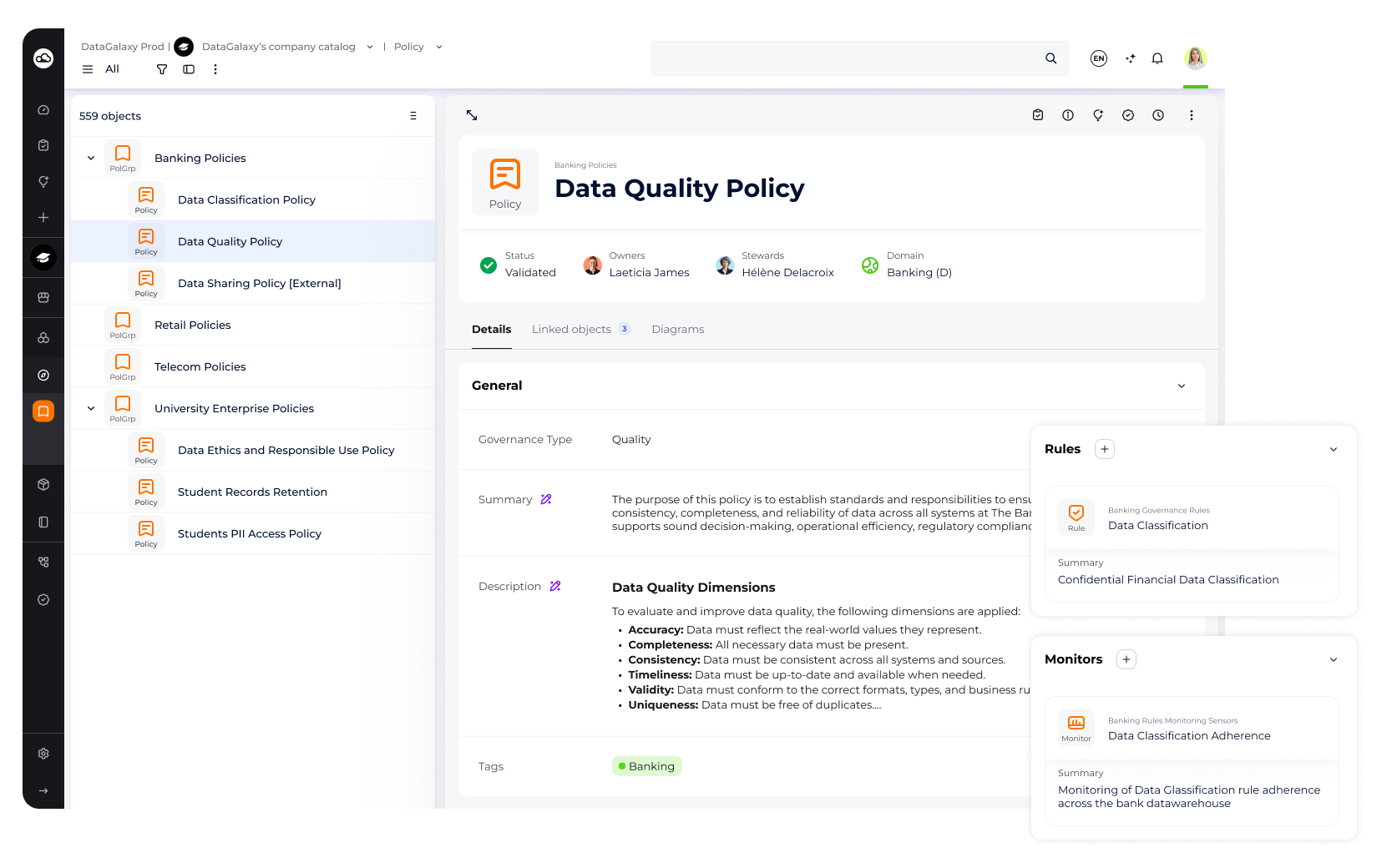

Data Governance Gartner
Data Governance Gartner is a strategic project aimed at positioning DataGalaxy in Gartner's Magic Quadrant, an international benchmark that evaluates and ranks data governance solutions worldwide.
This project is therefore part of an iterative learning process: each prototyping phase, each piece of feedback from Gartner, and each exchange with our customers allows us to refine our vision and identify the foundations on which to build a mature solution. The presentation to Gartner thus becomes an exercise in strategic validation that forces us to confront our concepts with the reality of the market and the expectations of analysts.
Goal
Position DataGalaxy in Gartner's Magic Quadrant as a credible and innovative player in data governance
Demonstrate a mature product vision on Data & AI Governance convergence, anticipating market developments
-
In 2024, DataGalaxy seeks to strengthen its position in the data governance market, a strategic but still immature area for its customers.
Gartner reports that 80% of companies fail to expand their digital business due to a lack of a modern approach to governance, making this topic a priority commercial lever.
Being included in Gartner's Magic Quadrant has therefore become a strategic objective: a place in this ranking provides international visibility and lends credibility to our product vision. To achieve this, we need to demonstrate our ability to operationalise data policy governance, an area that is still missing from our platform.
-
As a Product Designer, my mission will is to:
Translate Gartner's expectations into concrete experiences to be demonstrated.
Design user stories and interactive prototypes illustrating how the platform is used by different roles: steward, data owner, business decision maker.
Support the long-term ‘Data as a Product’ strategy by making governance understandable, actionable and measurable.
Finally, build a compelling demo for the Gartner Magic Quadrant 2024 within a very short timeframe, with an R&D and design-oriented team.

Gartner 2024 — Validation of a strategic concept
1. Construction of a prototype based on two key areas:
Policy setting: defining governance policies.
Policy enforcement: automatically applying these policies in systems.
2. Iterative work on high-fidelity models for a smooth, understanding-oriented demo.
3. Presentation to Gartner in September, focusing on the integration of these features into the product vision.
4. Addition of a monitoring component to enhance the initial proposal.
Result
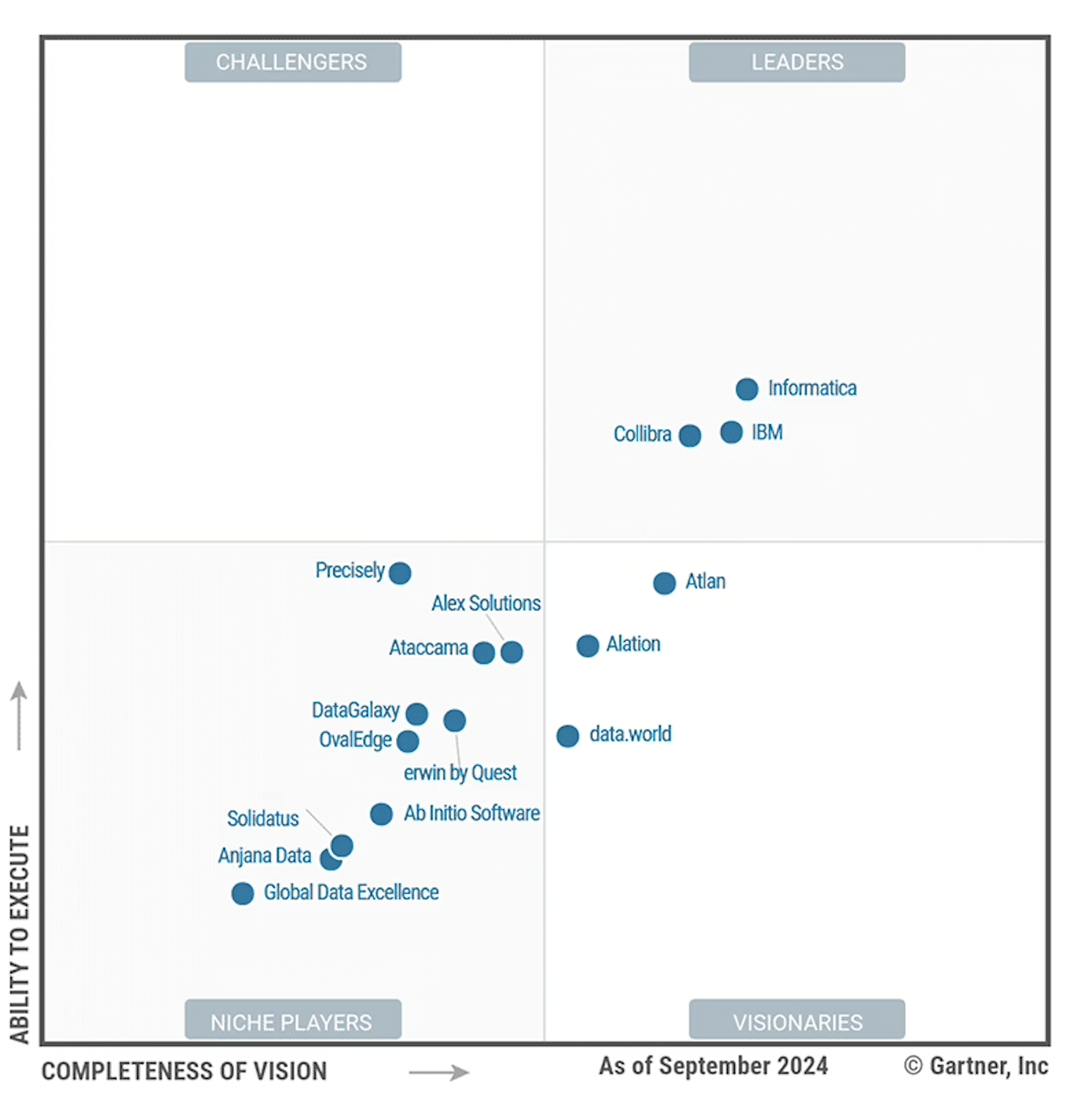
DataGalaxy is included in the 2024 Magic Quadrant as a ‘Niche Player’. This is a major recognition that validates the consistency of the vision and the relevance of the product assumptions.
Prototype for Gartner 2024 demo
Creating a rule
I’m a DataGalaxy steward and I want to create Rules, define their Scope, and use Policies to implement these rules effectively.
I will start by creating a Rule
Setting the Scope
I’ve created a Rule, now I need to set its Scope
Creating a new Policy
I want to create a new Policy as well as configurate its Perimeter and Logic.
Implementing a Policy
I’ve created a Policy, which I can now implement to my rule.
Phase V4 (2024 → 2025) — Strategic adjustment
After gaining recognition from Gartner in 2024, the context quickly changed: increased competition, new standards requiring the consideration of AI governance, and pressure to consolidate the platform in the face of international players.
In this context, the product strategy was readjusted: priority was given to stabilising and improving V4 rather than immediately developing new governance features. This decision was based on several observations:
User feedback showed a lack of market maturity: many customers had not yet structured their approach to data governance or specified their business needs.
Frequent confusion around vocabulary (‘rules’ vs. ‘policies’) required lexical clarification, illustrating the need for continuous adaptation of the product UX.
Strategic pause
The pause phase was not imposed but chosen in the interests of product accuracy:
Doubts centred on the advisability of developing advanced features when actual demand was uncertain.
The dilemma was whether to invest in features that our customers were not yet ready for or to focus our efforts on strengthening V4 to prepare for the future.
This period allowed us to clarify the value proposition, refine the strategic positioning, and lucidly prepare for the adoption of a more ambitious Data & AI Governance vision to meet the new Magic Quadrant criteria by 2025.
Design
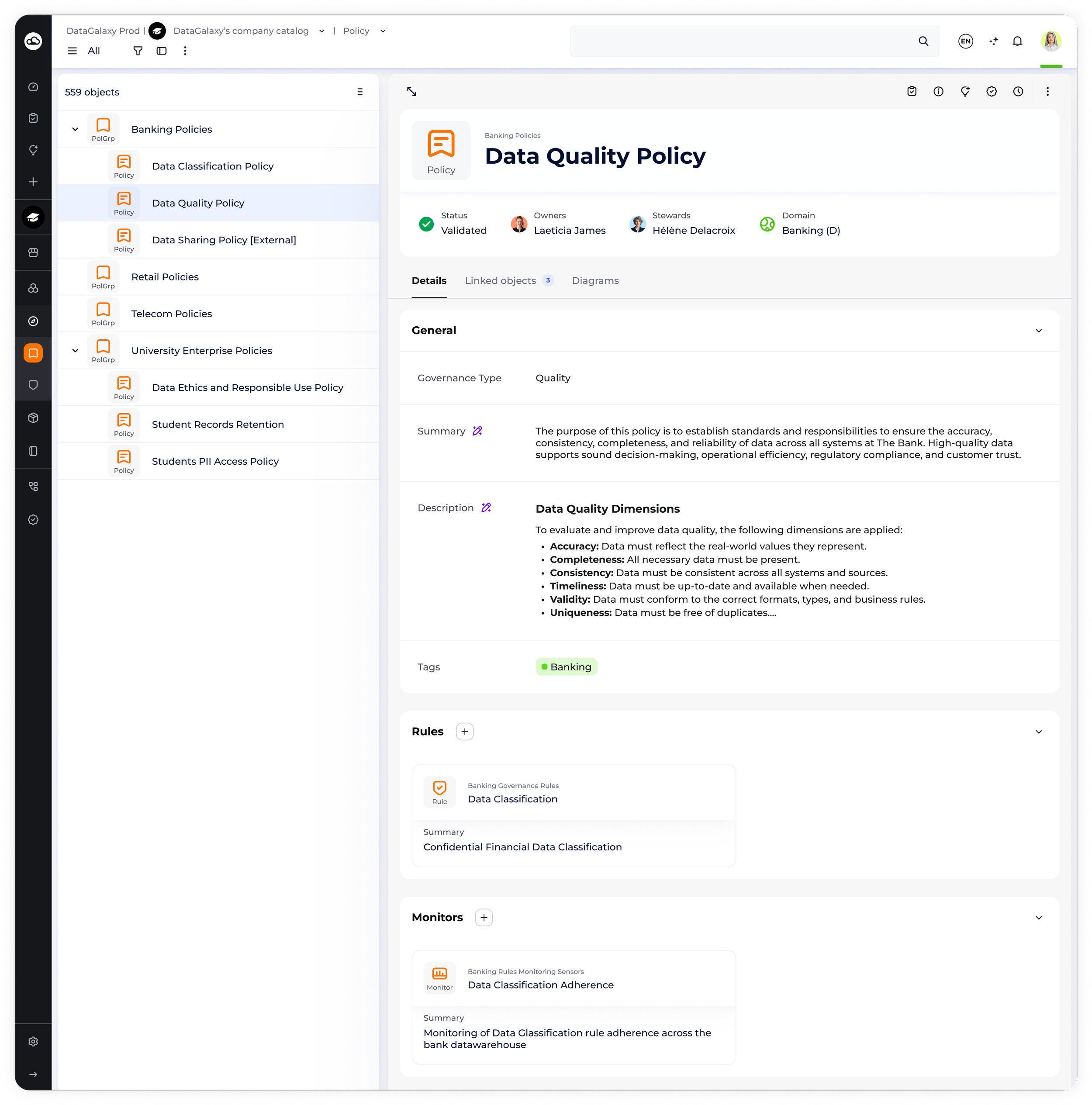
We took advantage of the redesign of the V4 data catalogue to modernise and clarify the data governance interface.
The focus was on the consistent integration of the concepts of Policy (global policies), Rules (specific rules) and Monitors (monitoring and control).
This new uniform lexicon facilitates understanding and adoption by all user profiles.
Gartner 2025 — Adoption of the Data & AI Governance vision
The strategy committee decides to relaunch the application.
The objective: to demonstrate continuity of vision while aligning with the new Data & AI Governance criteria.
This shift is based on several observations:
Evolution of standards: By 2025, Gartner will require governance capabilities applicable to AI (ethics, automation, traceability).
Widespread use of AI: AI applications are multiplying, increasing risks and requiring structured governance.
Essential automation: Governance must be proactive and integrated via intelligent agents (chatbots, co-pilots).
Market alignment: Only robust and open AI governance can combine innovation and regulatory compliance.
Gartner differentiation: DataGalaxy must demonstrate its ability to anticipate the convergence of data and AI in order to stand out in the Magic Quadrant.
User needs
Examples of user needs focused on data and AI governance.
Be guided towards the data governance process
Define the data policies to be followed
Apply the policies in the data systems
Monitor the deployment of governance

Which suggestions are awaiting validation?

What is the state of the catalog?
Business decision-maker
Reader
The Approach
Creation of a new video demo combining real products and seamlessly integrated prototypes.
Introduction of Blink chatbot, an intelligent governance assistant:
Guides users in defining and applying policies.
Proposes concrete actions based on the context and maturity of the user.
Represents the dual approach: AI for governance and Governance for AI (ethical governance of AI).
Two scenarios illustrate the value:
The Chief Data Officer models and deploys policies on student data.
The Data Steward verifies their operational application through automatic workflows and data traceability.
This approach, which is more conceptual than product-based, aims above all to validate DataGalaxy's long-term vision and ability to anticipate future developments.
Prototype for Gartner 2025 demo
Use case 1 : Policy Setting
Use Case : The CDO defines enterprise-wide rule (e.g., retention = 7 years, PII access rules).
Demo Story
The CDO at a university, defines that all student records must be retained for seven years and that PII access is restricted to authorized staff only. She models the policy in DataGalaxy, routes it to Data Owners and Stewards for sign-off, and enforces it through role-based governance rules and automated workflows.
Policies + Initiative warning and Campaign creation
Policies + Initiative a warning because enforcement coverage =0%
Ask Chatbot to launch a new “Governance policies deployment” workflow with the last 2 policies created
Use case 2 : Policy Enforcement
Use Case : Business data Steward ensures operational systems follow policies.
Demo Story
A Data Steward in the registrar’s office, ensures the student information system follows the retention and PII rules. She validates that the glossary definition of “Enrolled Student” is consistent across the CRM and ERP. Using lineage tracking, she reviews how student PII flows into downstream reporting and resolves an auto-assigned task when unclassified PII is flagged.
Creating a Monitor
A Data Steward in the registrar’s office, ensures the student information system follows the retention and PII rules. She validates that the glossary definition of “Enrolled Student” is cinsistent across the CRM and ERP. Using lineage tracking, she reviews how student PII flows into downstream reporting and resolves an auto-assigned task when unclassified PII is flagged.
Creating a Rule
For analytics part downstream in Snowflake she asks Blink to help her enforce the PII data privacy policy and authorize only access to PII data to the EU users. Blink creates a Masking rule which is then synchronized by the connector in Snowflake and the DO checks that it’s effective.
Results
Demo
Design effectiveness (2025): creation of an ‘illusion of reality’ video deliverable, combining UX storytelling and visual consistency, delivered on time.
Long-term vision: demonstration of an ability to anticipate market maturity, iterate on strong hypotheses and position the brand on the future of data governance and AI.
Magic Quadrant?
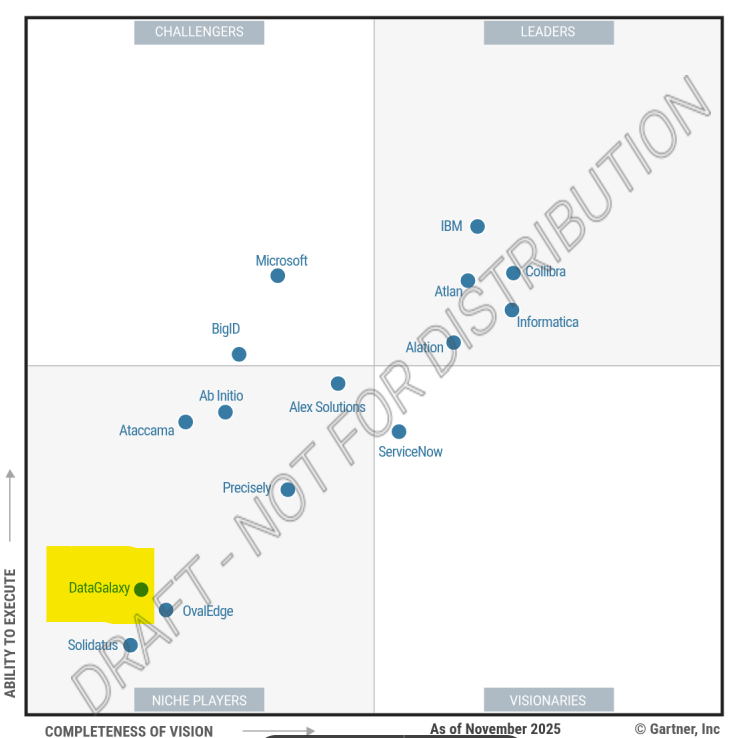
For this second edition, we have succeeded in being included in the 2025 Magic Quadrant, confirming our position as an innovative player. We are still recognised as a NICHE PLAYER, with a favourable overall assessment and recognition of our innovation in value governance. Despite the challenges of a rapidly changing market and strong competition, our team has demonstrated its ability to evolve with agility and vision.
Although our pace of execution is more moderate than that of some larger competitors, we remain proud to be ranked among the top 15 global players in our category. This position demonstrates our ability to successfully navigate a context of major AI-related transformations, with strong potential for future growth.
Learning and design impact
This project highlighted the balance that needs to be struck between external recognition and internal product maturity.
On the one hand, Gartner's validation reinforced the brand's credibility; on the other, the design approach served as a catalyst for clarifying the vision and foreshadowing product developments.
The work carried out between 2024 and 2025 demonstrates a strategic design approach capable of transforming a marketing exercise into an accelerator for product development, preparing the team for the next stage of the market: AI applied to governance.

Keep reading
More examples of design that drives results.