

-
The platform relied on a permission system based on modules and data sources, with multiple access levels. While functional, this approach created several challenges:
Complex and repetitive configuration for administrators
Limited control over visibility of sensitive information
A cluttered experience for non-technical users

How might we …
Simplify the management of user permissions so that admins can easily configure, visualize, and maintain complex access rules without repetitive manual actions?
Design Approach
As the product designer on this project, I drove the redesign in close collaboration with a product manager, engineers and developpers.
1) Workshops & alignment
We organized and facilitated workshops with engineers, and developers. These sessions helped to:
Clarify roles and responsibilities
Simplify rule structures
2) User Flows
Following the workshop, we defined simplified user flows to guide administrators in creating access rules.
The goal was to make complex configurations easier to understand while reducing errors and redundancies.

Introduce grouping mechanisms to streamline access management
3) Iterative delivery & milestones
Given the scope and technical constraints, I structured the project into several milestones. This approach allowed us to:
Prioritize key improvements and deliver value incrementally
Align design ambitions with technical feasibility
Introduce new capabilities progressively rather than in a single release
Each milestone built on the previous one, progressively improving the experience while ensuring smooth adoption.
Analyze impact
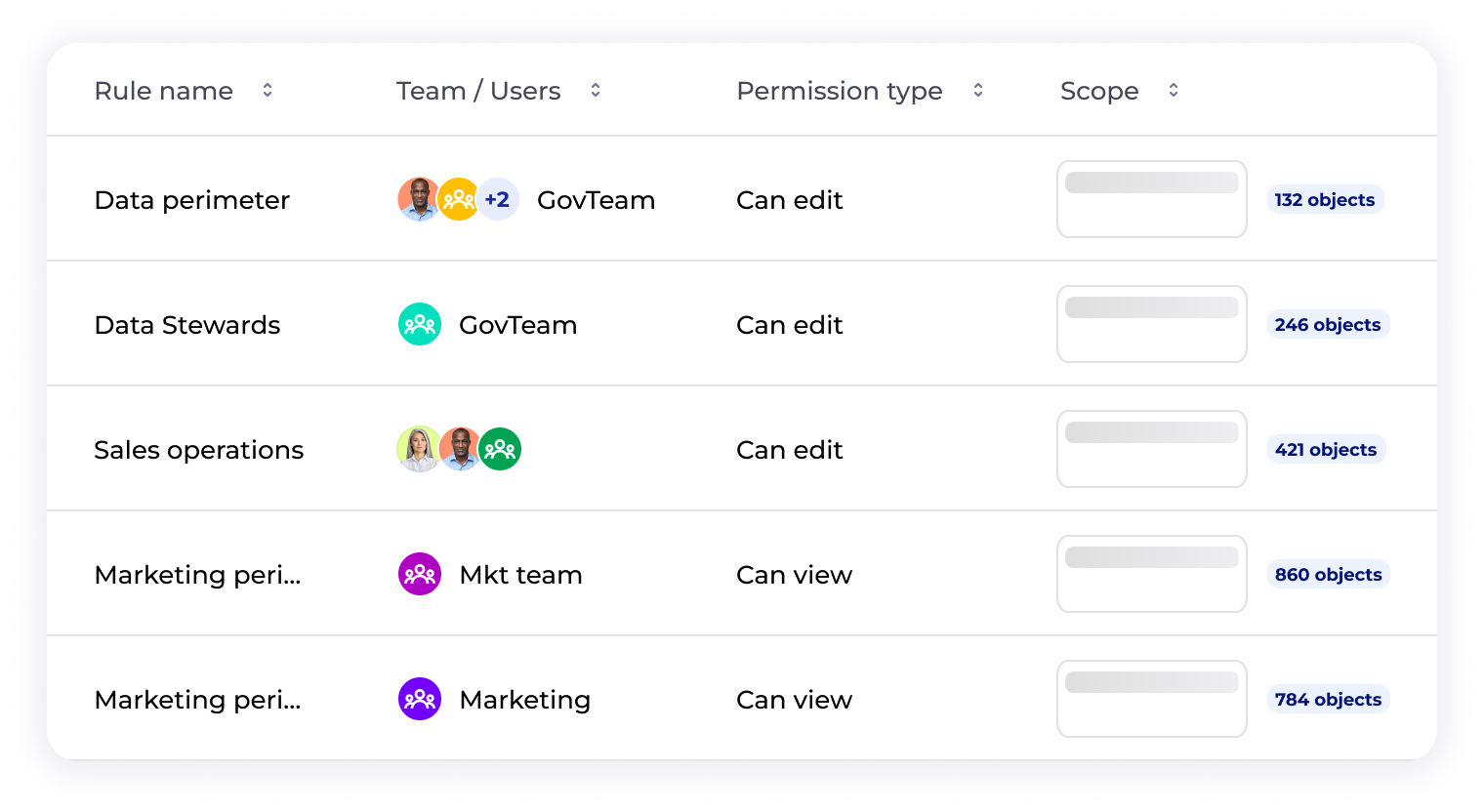
The new Access Control Management introduced an ABAC model and a group-based factorization that drastically simplified permission handling.
Rules are now centralized and reusable, allowing admins to manage access for multiple teams and modules from a single place.
This redesign brought clarity, consistency, and stronger security — users only see what’s relevant to them, while admins gain a global and auditable view of all permissions.
Up to 80 %
fewer repetitive configurations, instant rule propagation across modules, and a significant drop in access-related support tickets.
Business & User Outcomes
Drastic reduction of configuration errors and support tickets related to access issues.
Empowerment of workspace admins, who can now independently manage permissions without technical support
100 % of clients
adopted the new permission management system within weeks.
Keep reading
More examples of design that drives results.
